Run · #215811 · a bearing monitor · all out
Silent-Ear bearing lab
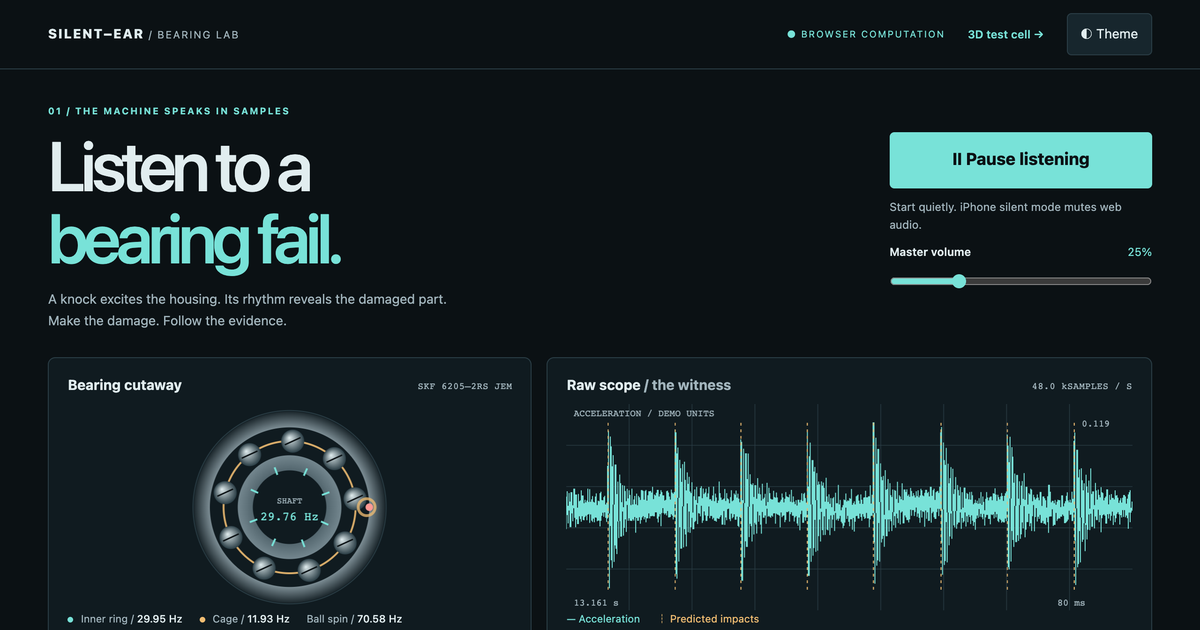
Hear a simulated bearing wear out, then follow its samples through the housing resonance and the envelope spectrum to a fixed mean + kσ rule. Every sound and number is computed in the browser.
silent-ear.neurabytelabs.com
Open the live demo →
The card
- verdict
- held
- model
- coding agent (a general class; the card does not name the model)
- duration
- about 59 minutes for the first run, then about 18 minutes for one follow-up round
- date
- 2026-10-08
The dare
build a bearing monitor from scratch, entirely in code, starting from individual accelerometer samples. design each layer on top of the last: bearing kinematics, defect impacts, a housing resonance, the overall RMS, crest factor and kurtosis, a spectrum analyzer, a band-pass filter, an envelope detector, an envelope spectrum, and a monitor that names the failing race or ball before the bearing seizes. everything has to be real: no setInterval clicks pretending, every sound and number must come from your samples. show it in a bearing cutaway and let me wear a bearing out, then zoom from the monitor down through the resonance into the samples while it runs. beside it, keep a raw scope with predicted impacts marked. treat it like you're proving you could have invented condition monitoring yourself. go all out.
How it was checked
Built from Proof of Invention prompt #215811 with a coding agent;
Mustafa Saraç designed the prompt machine and verified the result.
The dare comes from the atlas's version 2 entry
bearing-monitor and was sent with a written contract.
- An independent scipy check on samples from the page's engine puts outer race, inner race and ball faults on BPFO, BPFI (with shaft sidebands) and 2×BSF (with cage sidebands); healthy kurtosis is 3.00.
- One follow-up round fixed seven review findings, from an off-by-one record in the Rust rule to an unlabelled volume input.
- In the page's degradation script the RMS rule fires before kurtosis crosses its limit (70.0 against 77.3 simulated minutes). That is the opposite of the textbook order, and the page says so.
- Not verified: audio on a physical phone and screen readers.
A simulation and teaching tool: not sensor data, and not certified for safety-critical industrial use.